Monuments have recently become focal points for debates about history, politics, and social justice. In the United States, protestors have called for the removal of statutes of Confederate leaders. In South Africa, students advocating for the “decolonization of education” have succeeded in having a statute of Cecil Rhodes removed from the University of Cape Town. In Ukraine, a law about communist monuments has led to what Ukrainians dub “Leninopad”—the “Lenin fall”— most of the statutes of the Soviet leader have now been dismantled.
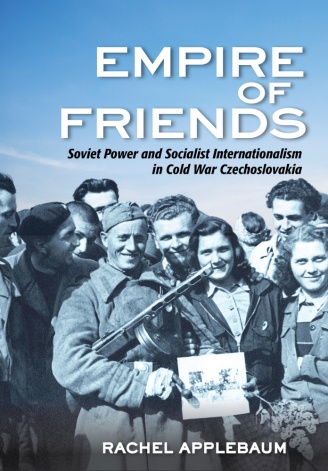 My new book, Empire of Friends: Soviet Power and Socialist Internationalism in Cold War Czechoslovakia, begins and ends with a monument in Prague. The monument was a Soviet tank: it was erected in July 1945 by Soviet and Czechoslovak leaders to honor the Soviet army’s liberation of Prague from German occupation in World War II.
A tank on the streets of a Central European city is the paradigmatic symbol of the Soviet Union’s oppression of its Eastern bloc satellites during the Cold War. A Soviet tank in Prague on a summer’s day remains an especially indelible image of the USSR’s violent efforts to maintain control over its socialist empire in Europe. It calls to mind the Soviet Union’s invasion of Czechoslovakia in August 1968, which crushed the country’s experiment in reform communism, known as the Prague Spring. In this familiar narrative of the superpower’s use of force against its satellite states, the 1945 monument to the Soviet Tank Crews in Prague is the foundation of Soviet hegemony in Czechoslovakia and the rest of Eastern Europe.
Yet long before the tank monument became a quintessential symbol of Soviet hard power in Czechoslovakia and the rest of the Eastern bloc, it was part of an audacious but less well-known experiment in power of a different kind: the attempt by Soviet and Eastern European officials to use transnational “friendship” to create a cohesive “socialist world.” This experiment, which involved cultural diplomacy, interpersonal contacts, and the trade of consumer goods across national borders behind the Iron Curtain, linked citizens of the superpower and its satellites in an “empire of friends” that lasted until the fall of the Berlin Wall.
Empire of Friends tells the story of the rise and fall of this friendship project between the Soviet Union and Czechoslovakia during the Cold War. The book’s central argument is that Soviet power in Czechoslovakia and the other Eastern bloc countries constituted a new type of empire—an empire of friends. I use this term to highlight the paradoxes of the relationship: between high politics and the realm of everyday life, amity and violence, cultural exchange and authoritarianism, and hard and soft power. The Monument to the Soviet Tank Crews in Prague illustrates this paradox. The monument employed a tank—a symbol of military force—to connote Soviet liberation and friendship. Over the course of the following four and a half decades, the tank monument became the most iconic symbol of friendship between the Soviet Union and Czechoslovakia.
Following the Soviet invasion in 1968, many Czechoslovaks came to see this symbol of soft power as a painful reminder of Soviet hard power. In the spring of 1991, in the aftermath of the Velvet Revolution, which brought an end to communism in Czechoslovakia, and not long before the collapse of the Soviet Union, a young Czech artist named David Černý undertook an act of political protest art. He painted the tank pink and stuck a giant model of a paper mache middle finger at its center. Protests that followed led the Czechoslovak government to move the offending monument to a military museum, where it remains today.
Rachel Applebaum is a historian of the Soviet Union, communist Eastern Europe, and the global Cold War. Her first book, Empire of Friends: Soviet Power and Socialist Internationalism in Cold War Czechoslovakia, is available for purchase, here.

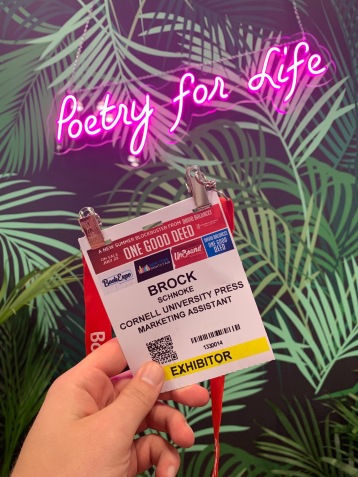 Booths upon booths filled with stacks of books in every genre, many available for you to take and read. The best booths were inviting and modern, with couches and chairs for you to sit, talk, read, or even charge your phones like we did in a cool poetry booth.

 Sage House News: The Cornell University Press Blog
You must be logged in to post a comment.